
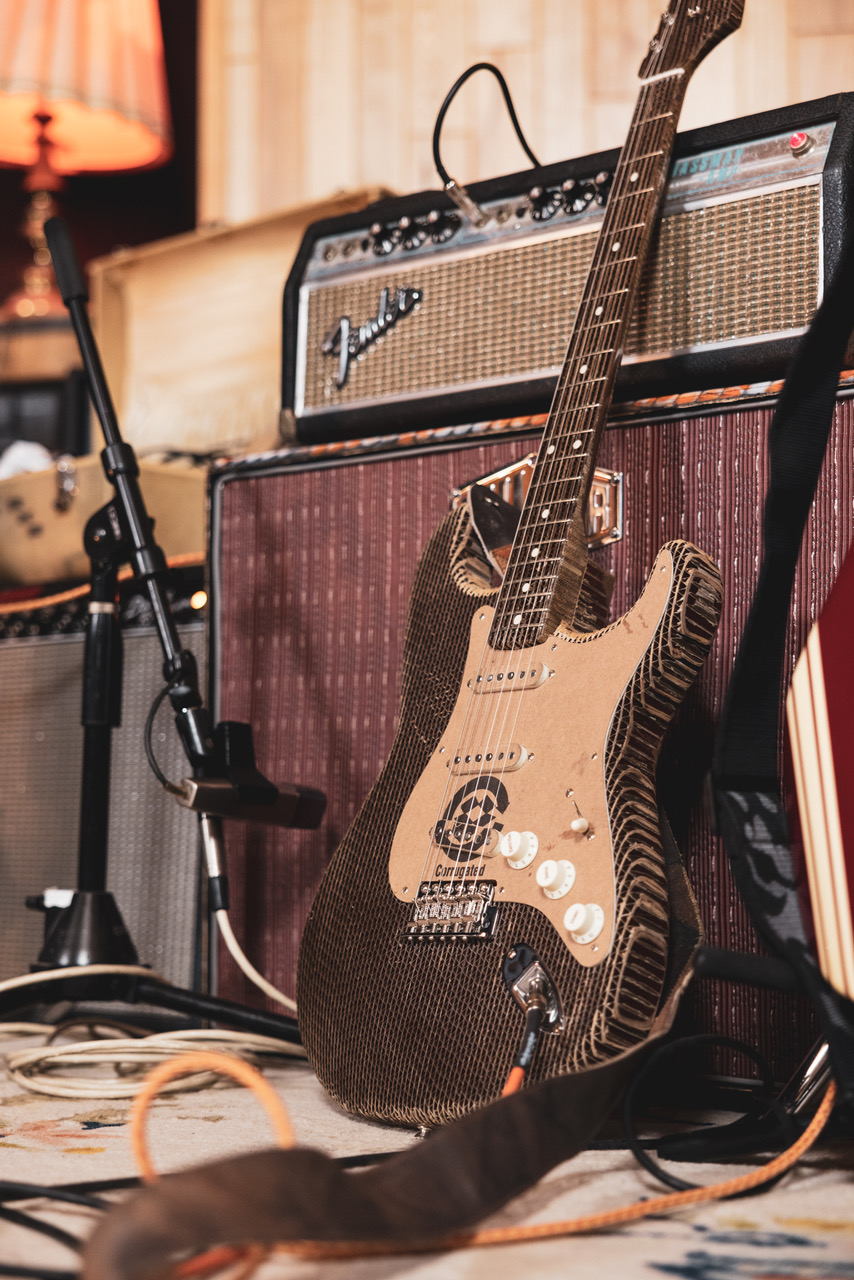
The internet has lots of weird shit to offer, but also includes amazing music sessions like NPR’s Tiny Desk Concerts, Triple J’s Like a Version, and BBC Radio 1’s Live Lounge. Cardboard Sessions has been out here, lovingly adding to the pile. Co-creator Dave Lee has turned UPS overstock packaging material into a full-blown creative playground where legends like Billy Gibbons, LP, Dogstar, The Dandy Warhols, and J Mascis plug in, freak out, and make shockingly great music on instruments built entirely out of cardboard.
Born from a pandemic-era hunger for connection and the dusty remains of a previous cardboard-instrument project, the Sessions have evolved into a manifesto of pure play with no bullshit — no rehearsals, no polish, no rules. Just cardboard, curiosity, and the kind of shit that happens when world-class musicians walk into a studio expecting a joke and walk out believers. We recently chat with Dave to talk engineering headaches, unexpected emotional moments, and why a cardboard drum kit might just be the warmest thing you’ll ever hear.

What moment or stray brain-spark actually birthed Cardboard Sessions — was it a genuine creative epiphany or more of a “what if we did something absolutely ridiculous” conversation that got wildly out of hand?
It started during the pandemic. I was watching bands play livestreams in empty rooms, trying to keep some form of live music alive. Meanwhile, the cardboard instruments we built for Cardboard Chaos were sitting in storage. I missed real music and real energy. At some point I just thought, “When this is over, I’m pulling those instruments out and getting friends to play them.” It wasn’t a gimmick idea. It was pure hunger for creativity and connection. That was the spark.
Cardboard is famously not a traditional acoustic material. How did you figure out what shapes, layers, and wizardry were needed to make these things not only playable, but good enough to get Pete to fawn over them?
A lot of trial, error, and stubbornness. And a team that actually knows how to engineer this stuff. Tim Wilson and Mike Martinez at Ernest Packaging have been working with Marc Wierenga and I to push cardboard into places it was never meant to go. It’s shapes, flutes, cross-corrugation, internal architecture, all designed to hold tension and shape tone. Once you start treating cardboard like a legitimate material, it surprises you. And yeah, when musicians like Pete pick it up and go, “Wait… this is cardboard?” that’s definitely the moment we want.
When you build an instrument out of cardboard, what’s the step that makes you say, “Okay… now it’s either going to sing or fold like a day-old taco”?
Stringing it up. That’s the moment. Up until then everything is theory and structure. The second you add real tension, you find out if your choices were smart or if you’re about to throw it all in a recycle bin.
Which cardboard instrument has been the biggest engineering nightmare so far — the one that had you questioning your life choices?
The drum kit. Hands down. Getting perfect cylinders out of cardboard is way harder than it sounds. Then you add hardware and head tension — it’s a pressure test torture chamber for paper. Mike Martinez and Sahir from Masters of Maple made it happen. And then the hollow body jazz archtop we just built with Gabriel Currie, that is also another level. A true “are we really doing this?” moment. But it’s beautiful. Worth every headache.
You’ve made guitars, basses, keys, a full drum kit… what’s the next frontier of cardboard mayhem? A saxophone? A Theremin? A tuba nobody asked for? IS IT A TIMPANI?
Oh, we talk about it all. Could we? Probably. Should we? That’s the question. The next frontier is usually whatever feels slightly unreasonable but still interesting. We follow curiosity, but a grand piano would be fun, also a stand up bass or cello would be sick.
How do artists react the moment they realize, “Wait… this is all cardboard?” Do they laugh? Panic? Immediately start shredding?
There’s always that pause. Usually followed by a laugh and delight in the outcome. Then the curiosity kicks in. Most of the artists we bring in are explorers by nature. They plug in, hit a note, and you can see the switch flip. Then they just start playing. It goes from disbelief to oh, hell yeah and excitement pretty fast.
You’ve had a LOT of great artists already, from Billy Gibbons to LP to Dogstar. Which session completely blindsided you — musically or emotionally?
Billy Gibbons with Matt Sorum walking in and creating a brand-new riff and song on the spot was unreal. Total masterclass from two legends. Dogstar was a big one too, Keanu showed up an hour early just to hang and get a feel for it, which was very cool. And LP brought a whole different emotional weight. Reignwolf with Brad Wilk is another I always point to… one take, that’s all it was. The energy was insane. But Billy’s session was one of those “I can’t believe this is happening” days.
Cardboard Sessions has this ethos of “invention over perfection, play over polish.” Did you intend it as a kind of artistic manifesto, or did it just naturally evolve into cultural commentary?
That’s a good question. The ethos from the start was to share that spark between musicians. We wanted it to live at the crossroads of art, invention, and instinct. No rehearsals, no script, just play. When you see that happen in real time, it’s powerful. It wasn’t meant to be a statement at first, but it naturally became one. Put cardboard instruments in front of great players and everything loosens up. There’s nothing polished to hide behind. It’s all instinct and honesty. In a world obsessed with perfect production, that hits differently. It ends up saying something bigger just by existing.

You document the building process in behind-the-scene videos. What’s the biggest misconception people have about cardboard instruments — anything that drives engineers nuts but artists think is magic?
Probably, that it’s easy to make. Then on the other hand, one had never been made until we played with the idea. The engineers put in serious work, load testing, resonance, structure, all those layers that keep things from failing. Some Artists have walked in thinking it’s a prop, then pick it up and go, “shit! I did not expect this” Engineering mixed with zero f**ks given is what makes the magic possible.
Every musician has a moment where an instrument “talks back.” Have any artists discovered new techniques or sounds that were only possible because the instruments were cardboard?
Absolutely. The drum kit has this warm, earthy thing going on that studios immediately want to sample. The guitars respond differently to attack and dynamics. Some musicians dig into that and find new textures. Most enjoy the character and feel of the cardboard.
If you could get any artist — living, dead, or otherwise mythological — to walk into the studio and pick up a cardboard Strat, who’s the holy grail Cardboard Session?
Tom Waits. No question. Jack White would be a dream. St. Vincent, Josh Homme, they all live in that world of experimentation. Those are the people who could take a cardboard instrument and make it their own instantly. Reignwolf is one of my holy grail moments, and I watch that one often.
What’s the endgame for Cardboard Sessions — a museum exhibit, a traveling cardboard orchestra, or just taking life one corrugated riff at a time?
If this becomes a go-to stop for artists the way some of the great live sessions are, that’s a win. We’re heading into year four in 2026 and I could see us doing Sessions in different cities. Nashville is high on the list. And honestly, some of these instruments should make it into production. Beyond that, we’re just following the energy. One corrugated riff at a time works pretty well.