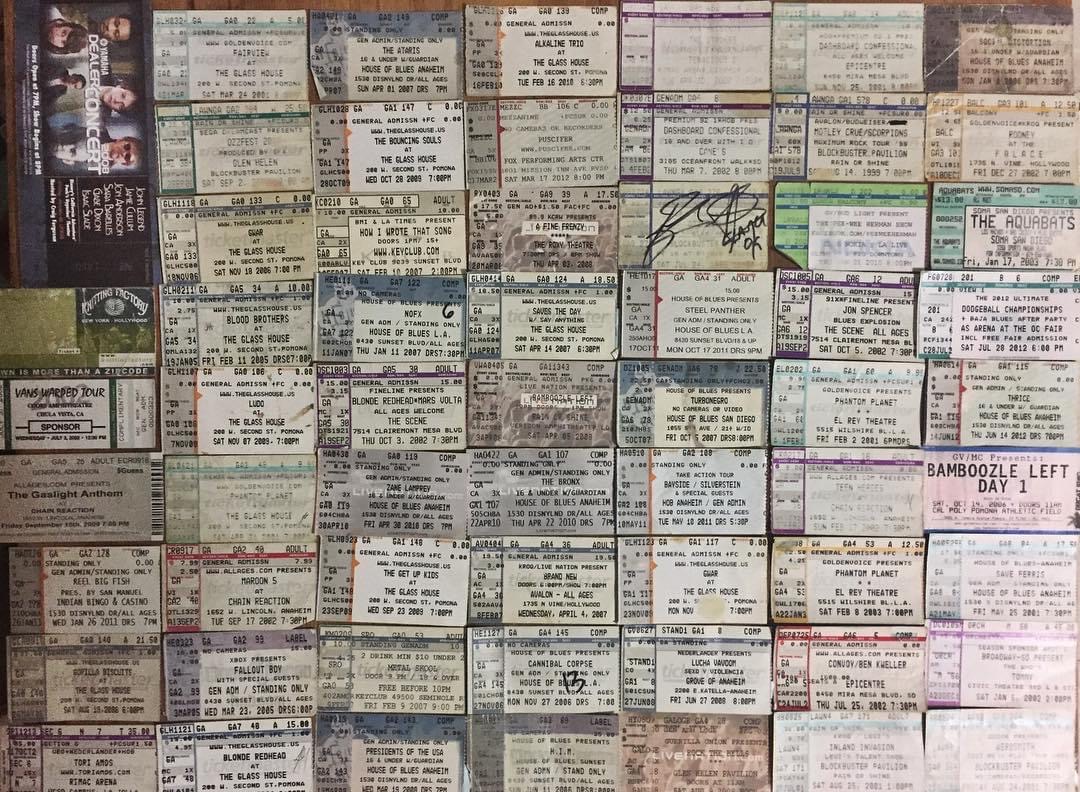
Last December, I lost a dear friend and I couldn’t even say goodbye. That friend? The Chain Reaction. An all ages venues whose website was literally allages.com. This was a storied venue, full of fights and makeouts, moshpits and first dates. And how did they go out? Just one last show in a narrow room in an awkward corner of Anaheim, CA.
Photo by Vince Apostol
And then it was gone.
If you grew up in Southern California’s punk, emo, indie, and hardcore ecosystem, Chain wasn’t just a venue. It was a rite of passage. It was the place where you learned how to stand your ground in a pit, how to scream lyrics with strangers, how to feel understood without saying a word. I haven’t lived in California in five years, maybe haven’t been to a show at Chain in 10, but I could still tell you where the merch table was set up, where the bands would load in, and where you were going to meet the coolest fucking people.
It was more than a venue, it was a third space before most of us knew what the hell that means.
Not Home. Not School. Something Better.
If you haven’t heard of the term, a “third space” is the place that exists outside of home (first space) and work or school (second space). It’s the arcade. It’s the skate park. It’s the coffee shop. It’s the bar. Hell, it’s the fucking church basement.
For some of us, it was a long, awkward room with t-shirts stapled to the walls, a low stage with a “no stagediving” sign that was more dare than a rule. There was a shitty merch table tucked in the back for all your t-shirt needs. It was the Chain Reaction.
I grew up sweating through the heat of California’s Inland Empire, hitting up shows at Showcase Theater or braving the drive to LA to duck into Key Club laying in the bed of my best friend’s mid-80’s Toyota pickup for two hour., But, if I was lucky, we were driving out to Chain Reaction.
We didn’t have much money. We didn’t have industry connections. We had $8 tickets, Sharpied X’s on our hands, and bands who were three albums away from either imploding or headlining Warped Tour. (really, I saw fucking Maroon 5 there. What the fuck?)
And in that small, awkwardly-shaped room, I found community.
Some of Racket Magazine ‘s first interviews were at Chain. I interviewed the Plain White Ts in the parking lot. I interviewed Bryce Avery of the Rocket Summer around the corner of the building. Racket’s Jeff interviewed the Wilhelm Scream in their fucking van.
Those interviews weren’t glamorous. They were sweaty. They were loud. They were perfect.
That’s also where I met Jon Halperin, booking manager extraordinaire — a man who treated twenty-somethings with shitty zines like they mattered. That kind of validation sticks with you. Years later, I ended up working shoulder to shoulder with him at Coachella and I thought I was going to explode.
It’s not an exaggeration to say those nights shaped my career.
Because of venues like Chain, I pursued a degree in music business. That path led me to work in live music PR as a professional music industry nerd.
Chain hasn’t been the only venue I’ve lost, though.
I once saw Yeah Yeah Yeahs in a club called The Scene, a nondescript box in a San Diego strip mall near a Planned Parenthood.
That sentence alone tells you everything about the early-2000s indie scene.
No VIP risers. No curated aesthetic. Just amps, concrete, and possibility.
I saw Dashboard Confessional at a youth center in San Diego called The Epicenter.. Kids were crying before that was monetized by TikTok. I also got to see Death Cab for Cutie with the Dismemberment Plan there. The Death and Dismemberment tour was tight as hell.
Places like The Scene, The Epicenter — gone. Ghosts now.
But they were laboratories. They were where bands figured out if they were going to survive. They were where kids figured out if they were.
As I attended Cal Poly Pomona, I got to know the staff at The Glass House. The security guards who pretended not to notice you sneaking a snack in. The bartenders who’d slide you a pint of the good stuff when you ordered a shitty well whiskey sour.
That’s the thing about small venues: they aren’t transactional. They’re relational.
You don’t just attend. You belong.
When a venue lasts decades — like UCSD’s stubborn, glorious Che Cafe — it becomes institutional memory. It becomes a generational handshake.
Now that I live in the Pacific Northwest, I see the same comradery here. I feel that same heartbeat at venues like Eugene’s the WOW Hall. The walls feel lived in. The sound feels honest. The room feels earned.
When Chain Reaction closed, we didn’t just lose a stage.
We lost a place to hang. A place to bond. A place to worship.
Small venues are economically fragile. Rising rents. Insurance costs. Shifting consumption habits. Streaming replaced record stores; algorithms replaced flyers stapled to telephone poles.
But no Discord server can replicate the feeling of your ribs rattling in a room full of strangers singing the same chorus.
These places create friction — the good kind. The kind that forges identity.
I’m not in music PR anymore.
I’m not backstage every week. I’m not pitching concert dates. My career moved on. But the foundation didn’t.
Everything I built — from festival publicity to casino concert campaigns to Racket’s own chaotic longevity — traces back to sticky floors and disgusting SM58s.
Small venues made me.
They made my friendships. My career. My taste. My magazine.
They made a generation of us.
And somewhere tonight, in a room that smells like spilled beer and adolescence, some kid is seeing their first show. They don’t know it yet, but they’re meeting their future.
That’s what a third space does.
It gives you back to yourself.
So if you have one left in your town — go. Buy a ticket. Buy a shirt. Tip the bartender. Learn the name of the person running sound.
Because once the lights go down for good, there is no encore, and that fucking blows.
I reached out to some friends of mine in the space and asked them the question: What do we lose when we lose a venue? Here’s what they said:
When I first started going out after high school, I attended some of my favorite indie venues, such as KAOS Network, which hosted Project Blowed. There was also Gabah, which hosted Elements. Then through Dub Club, I was introduced to The Echo/Echoplex.
However they are no longer indie after Live Nation took over around the dawn of the covid lockdown. These spots exemplified culture and authenticity through the events they hosted and were a huge impact on who I identify as today.
When small venues close or get bought out, you lose the welcoming aesthetic of feeling at home. It’s just business as usual. Pack em in, pack em out. On to the next.
Mine third space was Chain Reaction. So many of us owe so much to that little space, myself included. I was able to cut my teeth there- booking shows, designing flyers, playing gigs with my band Dear Life. I was a kid hungry to learn and get involved and this place allowed me to nourish the DIY mentality that ultimately made me who I am today.
Countless friendships and memories within those walls and in that parking lot. I feel so fortunate to have experienced it when we did and how we did. Truly legendary and irreplaceable. When venues like this close, we lose entire communities and ecosystems that depend on having a safe space for people to find themselves and their tribe.
I’ve been involved in the music industry for over 25 years, the music scene was ground zero for my social life. Places like Chain Reaction, DiPiazza’s, VLHS, Slide Bar, Doll Hut…I entered these places knowing I was entering community. Spaces of joy, noise, and solidarity that I can get lost in for a few hours surrounded by friends, ignoring the ongoing up and downs for life and, especially for my generation, the trauma from whatever world-changing events that were currently impacting American life going on at the moment.
At some point, the live music just becomes an added bonus at these venues, despite it being the drawing force that got us in the first place. These venues became my lifeline…the center of my social life.
Throughout the years, I’ve seen my fair share of venues close. Though our scenes shift and adjusted, it doesn’t at all negate the absolute loss these closures bring. Not only did we lose another space of where smaller bands can play, we lose another opportunity to share space and make friends from every walk of life. We lose out on opportunities to shape ideas and creativity. Spaces like this changed the trajectory in my life because it gave me the confidence and assurance that I belonged somewhere. I belonged here.
Jamie Rocha, Former Racketeer, tour manager for the Maxies, pal to Bite Me Bambi, Codename Rocky, Feed the Scene and more.
To me, The Fly Theater, our little hole in the wall in Victorville, was always a place I could go to let loose with my friends. We’d go even if we didn’t know any bands on the flier because it felt like a place where we just … belonged. When it closed shortly after I graduated, I could see the impact it had on the kids, when they no longer had a place to discover new music or express themselves.
I was able to take over the space and re-open it as Trilogy Theater with my good friend Travis after it had closed 4 years earlier. We managed to throw shows in various buildings and clubs for a good few years after, trying to provide the youth the same experience I had, paying it forward, I guess.
Memories ill always cherish. I love seeing the next generation finding these new hidden spots and discovering a whole world of cool ass music out there. There’s some fantastic bands coming out of small towns, with a huge resurgence in the indy DIY scene. Hopefully the cycle continues. The kids are alright
Jeff Curtis, former Racketeer and venue owner
Growing up in SoCal, places like Chain Reaction, The Glass House, and all the venues along the Sunset Strip were my first experiences with music as a live communal phenomenon, rather than just entertainment to be relegated to headphones or a video screen.
When these small venues close, it cuts out the heart of what ACTUALLY drives great music. Without the Cavern Club, there may have been no Beatles; without CBGBs, no Ramones or Talking Heads; without Central Saloon, no Nirvana or Soundgarden (and on and on).
These venues become vital hubs of humanity where loneliness is destroyed, friendships and even love is formed, and personal stories become a lifetime fixture in the fond memories of youth. Whenever a venue closes, it is impossible to tell how much beauty ends up becoming aborted.