
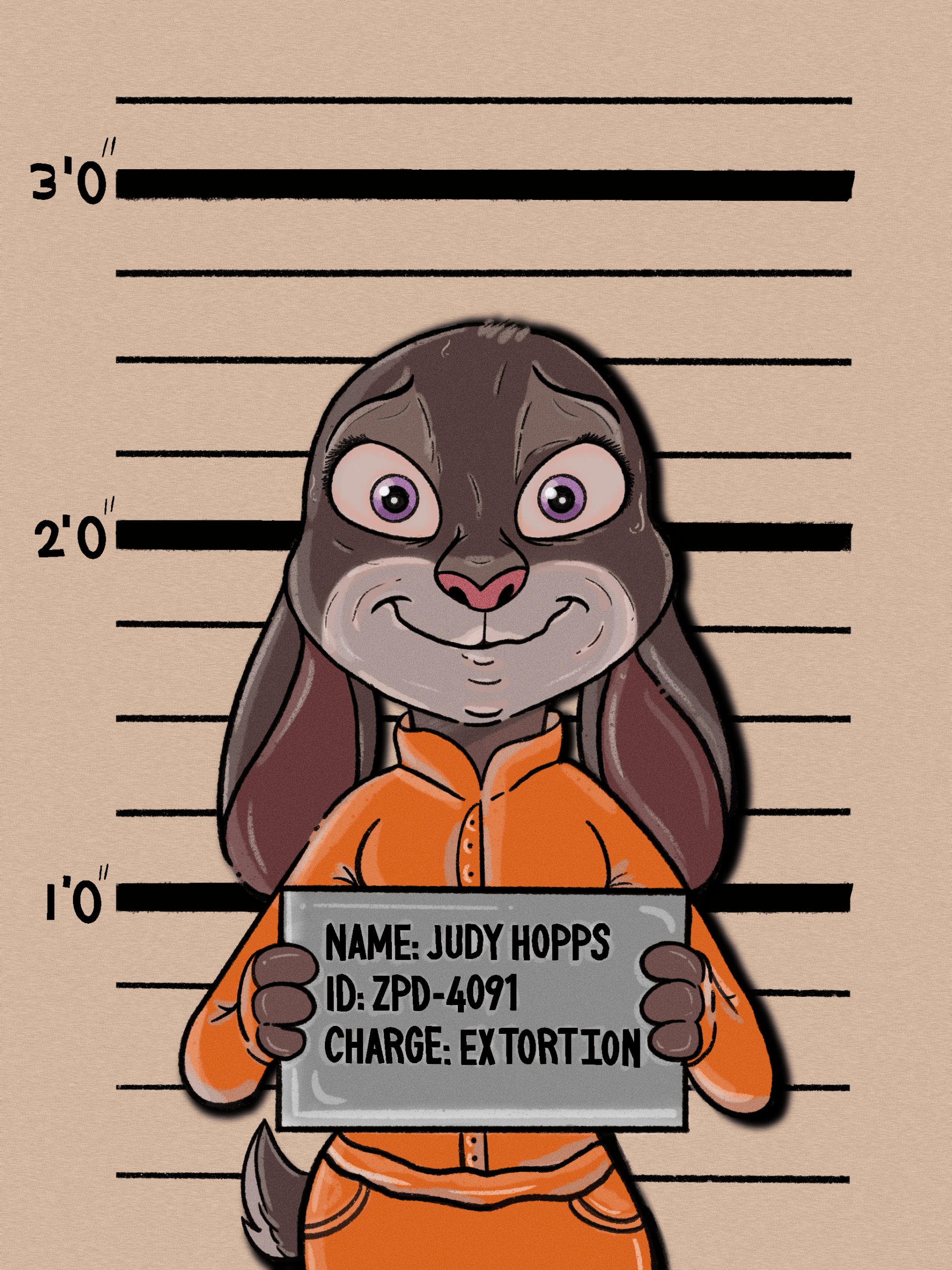
A week ago, I saw a LinkedIn post mocking Cars’ Lightning McQueen as an ego-filled jock whose motormouth was bigger than his, uhh, drivetrain? I dunno, there’s an analogy there somewhere. Anyway, it reminded me of a diatribe I subjected my wife to recently and that is: Judy Hopps should be in jail.
Zootopia is generally remembered as a movie about prejudice. It is also, perhaps accidentally, a movie about policing, rehabilitation and the strange ways people in power and systemic institutions decide who deserves a second chance.
It’s far deeper than the straightforward “don’t be racist” fable it portrays itself as. The central relationship in Zootopia is between Judy Hopps, an idealistic new police officer, herself fighting presupposed ideals of who can and cannot be a police officer, and Nick Wilde, a trauma-ridden fox who makes his living as a con artist.
The movie wants us to believe Judy represents the good intentions of an institution that can be reformed from within, while Nick represents the millions who have succumbed to the never-ending assault of society’s prejudices and pursues a life of crime in response.
But a closer viewing and you can see what’s really happening here. Judy doesn’t merely persuade Nick to help her solve a crime. She blackmails him with her dumb little pen.
She discovers evidence that Nick has committed a crime — tax evasion, a federal crime she has no jurisdiction to enforce — and uses a hidden recording to threaten him with prosecution unless he helps her investigate the missing mammals case. Makes one wonder if Zootopia is a one-party consent state.
It is played for laughs because Judy is the adorable protagonist and Nick is a sarcastic fox who rightfully enforced his rights, I mean, acted smug and condescending to the police officer, just one scene ago.
But strip away the anthropomorphic animals and the Shakira music for a moment. A police officer discovers evidence of criminal activity and uses the threat of state power, which they did not have, to compel a civilian to assist her personal investigation.
That’s not exactly a textbook example of due process, but it is an all-too-familiar story for low-income neighborhoods where people are forced into being informants.
And Judy’s motivation matters. She isn’t blackmailing Nick because she has been assigned to investigate him. She is trying to prove herself. Her ego won’t allow her to lose.
This is a young cop with something to prove, convinced she is destined to be a great police officer, who finds herself stuck writing parking tickets. She sees a mystery and decides she is going to solve it. Nick is useful. So she uses the authority available to her to get what she wants.
And it works.
More importantly, the Zootopia Police Department rewards her for it.
Judy eventually cracks the case, exposes the conspiracy, and is celebrated as a hero. She is given the opportunity to remain a police officer and, ultimately, becomes an even more prominent member of the department. The movie doesn’t stop to ask whether the methods she used to get there should concern us. (They should.)
That is where Zootopia gets unexpectedly interesting as a story about policing.
One of the ideas behind the slogan “all cops are bastards” — whatever you think of the slogan itself — is not simply that every individual police officer is personally terrible. It’s referring to the institutional solidarity often found within policing: the idea that police organizations can protect their own, particularly when officers step outside the rules they are supposed to enforce. Officers who do catch heat for violating the law are regularly re-assigned, moved to another agency, or promoted.
In that context, Zootopia offers a remarkably clean example.
Judy breaks rules in pursuit of what she believes is a righteous goal. Her actions produce the desired result. Rather than seriously examining the means, ZPD celebrates the outcome. Not two days after wanting to fire her. But shine a glowing little light on the agency, all is forgiven.
The message is not necessarily that Judy is evil. Quite the opposite. The more uncomfortable message is that good intentions can make institutional misconduct look acceptable — particularly when the person doing it is ultimately proven right.
This is a dangerous standard for any institution built around the power to compel people to do things they don’t want to do.
And then there is Nick.
Nick is arguably the movie’s more radical character because his story suggests something the police institution doesn’t: people can change for the better when you give them a reason to.
Nick is a con artist because, in large part, he has learned that this is what the world expects from him. He was a rock worn down by the waves of prejudice, becoming a smaller version of who he wanted to be: part of a pack.
As a child, he wants to become a member of the Junior Ranger Scouts. He shows up excited to participate, only to be assaulted by a group of prey children who decide that because he is a fox, he must be dangerous. They muzzle him. They humiliate him. They tell him what he is.
And Nick learns the lesson. People will judge him because of how he was born, not what he does. So, he gives up on doing anything different, now traumatized by his would-be pack.
If the world is going to treat him like a criminal, perhaps there isn’t much point in trying to prove it wrong. So, he becomes one.
That is one of the movie’s most effective observations about prejudice: stereotypes don’t simply describe people. Sometimes, they help create the conditions that make the stereotype appear true. A self-fulfilling prophecy sprung from bullshit.
Nick is not born a criminal. He becomes someone who has figured out how to survive in a society that has already decided what he is.
And yet the movie gives us another fascinating character in the same universe: Gideon Grey.
Gideon is introduced as a bully. As a child, he is openly prejudiced against Judy because she is a rabbit. He scares her, insults her, treats her as inferior, even maims her in an assault meant to “keep her in her place.” Years later, however, Judy discovers that Gideon has changed. He is no longer the vicious kid she remembers. He is running a bakery and has become, by all appearances, a productive member of his community.
The movie doesn’t demand that Gideon spend the rest of his life paying for the person he was as a child. That’s how it should be. Because if we actually want to believe in rehabilitation, then rehabilitation has to mean something.
A person who has committed a nonviolent crime should not be defined by that crime for the rest of their lives. A person who made terrible decisions at 16 should not automatically be presumed incapable of becoming a decent 30-year-old. A criminal record can tell us something about a person’s past, but it doesn’t necessarily tell us who that person is today. Are you the same person you were at 16? Doubtful.
Zootopia understands this when it comes to Gideon. It understands it with Nick, too — eventually.
And yet Nick’s story raises an even more uncomfortable question: how much earlier could his life have changed if the society around him had offered him belonging instead of contempt?
Nick’s childhood experience didn’t happen in a vacuum. Those children did not invent the idea that foxes are dangerous. They learned it somewhere.
Kids are capable of cruelty, certainly. But when a child has a fully formed vocabulary of racial or, in this case, species prejudice — when they understand that someone deserves to be humiliated because of what they are — it is reasonable to ask where they learned it.
Children aren’t born knowing whom to hate. Someone teaches them.
Someone taught Gideon that rabbits were small and useless, so he acted accordingly. Judys dad taught her to be prejudiced against foxes, an allegory with additional subtext of “those large aggressive folks on the farm.”
And that matters because the movie’s solution to prejudice is ultimately interpersonal. Judy learns to see Nick differently. Nick learns to trust Judy. They become friends. Their relationship changes both of them.
But there is a larger structural lesson sitting underneath that story.
Nick didn’t need another lecture about being a fox. He needed a reason to believe he belonged.
He needed community. He needed purpose. He needed someone to believe that there was something more available to him than being the guy who hustles tourists, sells contraband popsicles, and runs elaborate scams to get by.
Once he gets that opportunity, he changes.
And perhaps that’s the most consequential idea buried inside Zootopia: rehabilitation isn’t merely about telling people they should behave better. It is about creating circumstances in which behaving better is actually possible.
Meaningful work helps. Community helps. Being trusted helps. Having something to lose helps. Being treated as though you are capable of being something other than your worst decision helps.
That is a very different philosophy from the idea that punishment itself is the primary solution to criminal behavior.
Which brings us back to Judy fucking Hopps.
The movie’s great irony is that the character who initially demonstrates the most faith in the criminal justice system is also the character who most blatantly steps outside its rules.
She believes deeply in the badge, but when the badge isn’t giving her what she wants, she finds another way. Judy Hopps doesn’t give a flying fuck about the law, she is a vigilante with a badge.
Nick, meanwhile, starts out believing the system has nothing to offer him. His experience has taught him that the rules aren’t really for people like him.
And yet Nick is the one who ultimately discovers a legitimate place within the system.
The fox becomes a cop. The criminal becomes an officer.
The person who had spent his life being told what he was becomes someone capable of deciding for himself who he wants to be.
That is a genuinely hopeful ending, even if ACAB now means Nick Wilde.
It is an ending that makes the movie’s treatment of policing worth questioning.
Because if we want to celebrate Nick’s rehabilitation, we should probably extend the same generosity to other people who have criminal records. If we believe people can change, we shouldn’t build systems that make their past mistakes permanent barriers to employment, housing and belonging — particularly when those offenses were nonviolent and the person has demonstrated that they have changed.
And if we believe policing is supposed to operate within the law, we should be willing to apply that standard even when the cop is the protagonist, the victim is unsympathetic and the outcome makes for a satisfying Disney ending.
Maybe that’s why Zootopia has stuck with me. It is ostensibly a movie about overcoming stereotypes. But underneath the talking animals and buddy-cop jokes, it accidentally asks a much harder question:
What if the way we treat people helps determine who they become?
The movie gives us two answers.
One is a police officer who breaks rules because she is convinced that she’s right — and is rewarded when she turns out to be right.
The other is a criminal who eventually stops being a criminal because someone gives him a reason to believe he can be something else.
One story is about getting results. The other is about getting a second chance.
And I’d argue the second story is the one Zootopia should have spent more time telling us about.
Or maybe, I should not think about it too much, it’s a Disney movie about talking animals and I am SIGNIFICANTLY overthinking this.